

Mercer Island Real Estate
How the island fits together, and what makes one Mercer Island home different from another.
Mercer Island is small on the map, but its properties are not interchangeable. This page covers how the island is oriented, what everyday life looks like, and what actually separates one property from another. The general guides to buying and selling cover the process.
Getting oriented on the island
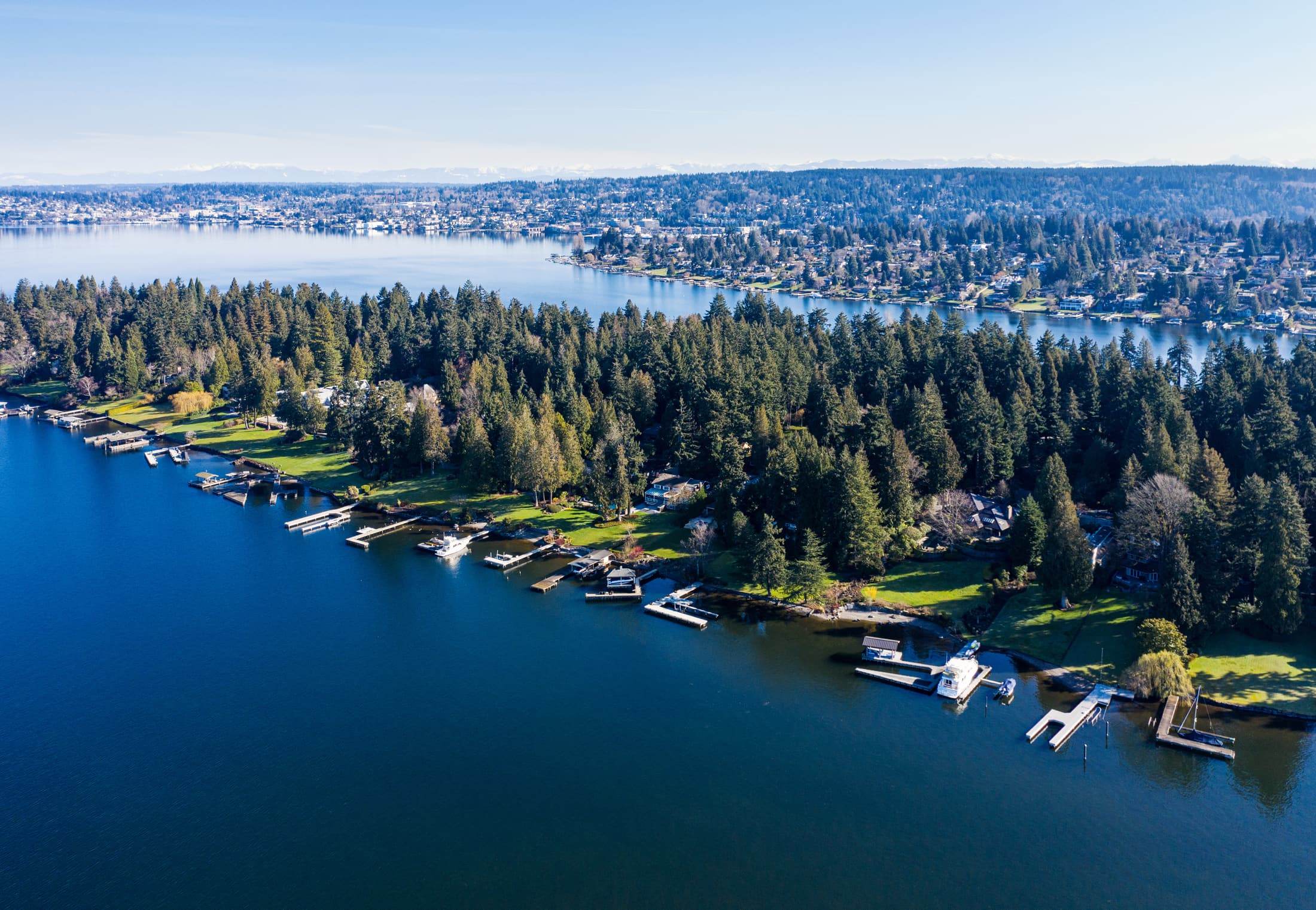
Mercer Island is a long, narrow island in Lake Washington, with Seattle across the water to the west and Bellevue and the Eastside across the water to the east. Interstate 90 crosses the north end and is the island's road connection to both, which is why the north end and Town Center are the most directly connected.
The island at a glance
| Where | What to know |
|---|---|
| Seattle | Across the water to the west. |
| Bellevue and the Eastside | Across the water to the east. |
| Interstate 90 | Crosses the north end and is the island's road connection to both. |
| Town Center | The core commercial district at the north end, near I-90. |
| West Mercer Way and East Mercer Way | Run along the west and east sides, with interior streets between and off them. |
North end and south end are practical ways of saying where you are, not boundaries. The differences between properties show up street by street, not in neat zones. The east and west sides differ in sun, outlook and the water: east-facing waterfront can be spectacular, and west-facing waterfront has its own appeal, including evening light. But a location label is only the beginning. The real question is how the specific street, setting and property change the way the home lives. A road name alone doesn't say: a home on East Mercer Way can sit in a surprisingly quiet interior setting.
Everyday life on the island
I-90 is the island's road connection to Seattle and Bellevue, and a property's distance from it shapes how near or far different parts of the island feel. Town Center, the core commercial district at the north end near I-90, is where many everyday shops, restaurants and services are concentrated. The City of Mercer Island operates parks around the island, including beaches and street ends with access to the lake, so being near the water doesn't require private waterfront. The City's parks page shows them. For schools, the Mercer Island School District is the source for district information.

Same size. Different real estate.
Two Mercer Island homes can show the same square footage, the same bedroom count and the same asking price, and still be very different real estate. Those numbers are where a comparison starts, not where it ends.
The house is only part of the purchase. The lot, orientation, light, privacy, access and view matter as much, and they are the hardest things to change. You can remodel a kitchen. You usually can't remodel your way into a better lot or a better orientation. Two properties that look equivalent online often separate quickly once you see the street, the light and the yard.
Comparison: Same stats on paper, different property
Illustrative, not real properties. Both houses have similar square footage, bedrooms and asking price.
| What to look at | House A | House B |
|---|---|---|
| The yard | Flat and usable | Steep, with little usable space |
| Privacy | Closer to the road | Screened and quiet |
| Light | Shaded part of the day | Open, with sun through the day |
| The approach | Level driveway, easy parking | A steeper driveway |
| View | None | A real view, partly dependent on trees |
| Condition | Polished remodel, little left to do | Dated, with work ahead |
| Future | What you see is what you get | Possible upside, still to be verified |
Neither is the better house. They are different purchases for different buyers, and nothing on a listing sheet would tell you which is which.
Waterfront: the whole experience
Waterfront is a spectrum, not a yes-or-no feature. Buyers pay for the whole experience, not for one measurement. A property with less frontage and an exceptional relationship between the house and the water can be more compelling than one with a bigger frontage number that is harder to use day to day.
Checklist: Where a waterfront property sits on the spectrum
- Frontage, and how much of it is actually usable
- Orientation and sun: open to the light, or shaded
- Privacy and views
- Access to the water: an easy path, or a steep one
- Dock or moorage, and whether it fits how you would use it
- The usable yard near the water
- Lot depth and overall quiet
- The house and the water: whether the main living spaces take advantage of the setting
The usual surprises: less sun than expected, steep or awkward water access, limited usable yard, a dock setup that doesn't fit how you want to use it, less privacy than the photographs suggested, a house that is physically disconnected from the water, and complexity that's easy to underestimate.
Frontage, dock and shoreline questions are property specific, and they belong with the right professional and the City. The buyer's guide and the seller's guide cover how to approach them.
Older homes, remodels and additions
Older homes are found throughout the island, and many have been remodeled, added onto or changed more than once. Age by itself isn't a negative. An older house can sit on a great lot with real character, better orientation and a layout that works, and sometimes the value is in the underlying property more than in the current improvements. Condition, maintenance and execution matter more than age.
A strong remodel isn't the same as an expensive one
A remodel doesn't add value simply because money was spent on it. Will looks at layout and circulation, how an addition connects to the original, workmanship, and the systems and structure behind the finishes. A weaker remodel can look expensive and still create awkward circulation, mismatched spaces or unanswered questions. Drainage and water, foundation and structural history, the roof and exterior, and retaining walls often say more than the age of the house.
Lots, slopes, trees and drainage
A bigger lot isn't automatically a better lot. Usable space often matters more than raw size: a flat, usable yard can be worth more to a particular buyer than a larger lot that is steep or hard to use. Privacy, light, the approach and driveway, trees, lot shape, road position, drainage and access all shape how a lot actually works.
On Mercer Island these often show up together. A beautiful lot may also have a slope. Trees create privacy and character and can matter to a future building idea. Drainage depends on topography and the way water moves across a particular site, and retaining walls, older foundations and earlier site work matter on some properties. None of that is automatically a problem. Slopes vary almost block by block, and a surprisingly flat, usable lot can sit in a part of the north end full of older homes. There's no simple rule such as flat in the north and steep in the south.
An open question isn't a red flag, and possibility isn't feasibility. A large lot or an older house can suggest an addition or redevelopment, but the idea should be treated as certain only to the extent of the information behind it. This site doesn't make general statements about what can be built, tree removal, shoreline rules, slope classifications, setbacks, lot coverage, height or critical areas. Those are property specific, they change over time, and they're confirmed by the City and the right professionals. The buyer's guide and the seller's guide show how to sort what is known from what is assumed.
Buying or selling on Mercer Island
Because the island is small, it's easy to assume property quality is fairly uniform. It isn't, and the stronger purchase is sometimes an older house on a much stronger lot, not the newest remodel. Turnkey isn't automatically the better purchase, and an older home isn't automatically a value play. The property and the buyer's priorities decide. Most buyers weigh tradeoffs:
- Turnkey condition, or a stronger underlying property.
- A view, or a flatter, more usable yard.
- Waterfront, or easier access and lower complexity.
- A larger house, or a better lot.
- North-end convenience, or another part of the island with a different mix of privacy, view, waterfront or lot.
- Character, or newer construction.
Locally, buyers reward quality, and quality is broader than finishes: a strong lot, good light, privacy, views, waterfront, usable outdoor space, a good layout and a well-maintained home. A house can be good and still be mispositioned. Price reductions, a long time on the market or weak activity don't automatically mean the house is bad. They can mean the price, the positioning or the buyer fit was wrong. The buyer's guide covers the buying process, and the seller's guide covers preparing, pricing and launching. If you'd like to talk through your own home, you can request a home valuation.
How the market here works
Closed comparable sales matter, but they aren't enough. A property's value story also depends on a simple question: what else can the buyer purchase today at this price? Will looks at:
- Active and pending listings.
- Days on market, price reductions and relists.
- The cumulative market history, not just the current listing period.
- The alternatives a buyer actually has right now.
One property can make another look expensive, or compelling. Supply and demand move together, and different property types can behave differently even within the same island market.
Working with Will on Mercer Island
Will Russell is a Mercer Island native, a Broker with Real Residential, and a founding member of the firm's Mercer Island office, with more than two decades of experience spanning real estate, construction, remodeling, and project management. A builder's eye. A broker's focus.
Questions that belong to a surveyor, engineer, architect, the City or another professional go to them. His job is to recognize those questions early and help you understand what the answers mean for the purchase or sale.
Mercer Island is his primary market and where he's rooted, and he also works with buyers and sellers across Bellevue, Seattle, Kirkland, and the broader Eastside.
Ready to talk it through?
A short conversation is an easy way to start, whether you're looking at Mercer Island homes or thinking about selling one.